Brist's Three Great Names: Kačić Miošić, Srećko Diana and Mladen Veža
Brist is a village of fewer than 400 people at the southern end of the Makarska Riviera. Most visitors come for the sea and stay for the quiet. But walk through the village with open eyes and you discover something unexpected: this small fishing village has given Croatia a national poet, a poet of the sea and one of its most celebrated painters.
The oldest of the three is fra Andrija Kačić Miošić, born in Brist on 17 April 1704. He became a Franciscan friar, taught philosophy at the monastery in Zaostrog and in 1756 published Razgovor ugodni naroda slovinskoga, A Pleasant Conversation of the Slavic People. Written in verse, in the language ordinary people actually spoke, it told the history of the South Slavs through songs. It became one of the most widely read books in Croatian literature and helped shape the Croatian language. He is still known affectionately as Starac Milovan.
In front of the parish church of St Margaret, right by the sea, stands his bronze statue. It is the work of Ivan Meštrović, Croatia's most famous sculptor, who modelled it in New York in 1953 and gave it to Brist. It was unveiled on 30 September 1960. Meštrović had wanted it outside Kačić's birth house, but the friars persuaded him that the church square was the better place, and when you see it against the sea you understand why. The remains of the birth house, above the main road, are a protected cultural monument and were restored between 1990 and 2004.
Brist's history goes back much further than its famous sons. In the cemetery, next to a memorial plaque, stands the old parish church, also dedicated to St Margaret. It was built in 1751 on the site of a fifteenth-century church, whose apse still survives inside it, and it holds eighteenth-century tombs of the Kačić family. It has been a protected cultural monument since 1966. Down on the rocks by the sea, the small chapel of St Anthony of Padua dates from 1807.
Srećko Diana was born in Brist on 6 March 1906. He became a poet, essayist and playwright, ran the city archive in Split and later worked at the city museum there. His poetry, spare and inward, kept returning to the Adriatic, in collections such as Okus ljeta (The Taste of Summer, 1963) and Iskustvo mora (The Experience of the Sea, 1969). He became known as the poet of the sea. It is hard to think of a better title for someone who grew up in Brist.
Mladen Veža was born in Brist on 7 February 1916 and moved to Zagreb as a boy. He studied at the Academy of Fine Arts under Vladimir Becić, graduated in 1937 and taught in Zagreb for decades, becoming one of the most important Croatian painters of the twentieth century. However far he travelled, Brist remained his great subject. He painted it again and again: from the slopes of Biokovo, from its lanes and olive groves, and above all the church of St Margaret.
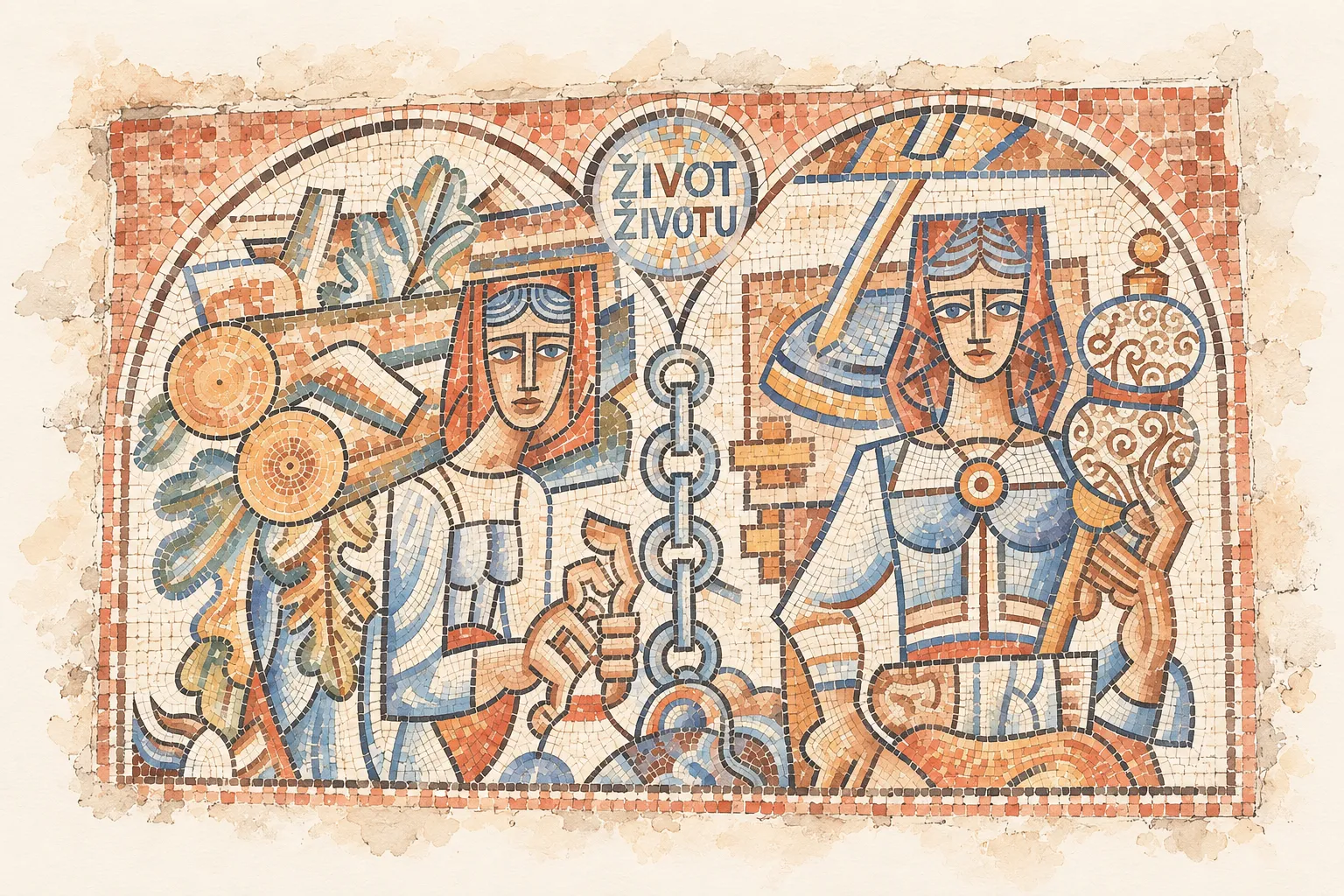
His most personal work in Brist is on the wall of his own house in the middle of the village. From 1966 to 1979 he assembled a mosaic called Život životu, Life to Life, from ceramic fragments gathered on the beach in Brist. Two tall figures stand surrounded by symbols of village life, and the mosaic was never actually finished, which somehow makes it even more moving. Stop and look closely: every piece of it once lay on the shore a few steps away.
In 1993 Veža and Diana both received the Vladimir Nazor Award for lifetime achievement, Croatia's highest national award for the arts. Two men from the same small village, honoured in the same year.
You can see it all on an easy morning walk. Start at the church of St Margaret by the sea, with Meštrović's statue of Kačić and the view Veža painted so often. Walk into the village to find Život životu on his house, continue to the old church in the cemetery, where members of the Kačić family are buried, and finish above the main road at the restored birth house of the poet. Afterwards, go back down for a swim. It is what all three of them would have done.
The village keeps their memory alive. In the summer of 2026 Brist marked anniversaries of all three with an exhibition, a concert and a literary evening in front of the church.
Our family's three stays are at the calm end of Brist, an easy walk from the church and the mosaic. If you would like to spend your holiday in the village that shaped a poet of the sea, send us your dates and we will reply personally.
Frequently Asked Questions
Next article